

A concert hall with 10,000 fans on their phones. A university auditorium where every student is on a video call. A warehouse floor running hundreds of IoT sensors alongside handheld scanners. These environments don't need a good Wi-Fi access point, they need one that was explicitly built for them. That's what the OmniAccess® Stellar AP1540 series is.
Two models, two antenna strategies
The AP1540 series comes in two variants and the choice between them is determined by your RF environment, not just your budget.
AP1541 with integrated omnidirectional antennas: The natural fit for standard enterprise spaces: conference rooms, hotel lobbies, lecture halls, large open offices. Clean ceiling mount, no external cabling, consistent 360° coverage.
AP1542 with 8 external antenna connectors (RP-SMA): Designed for the environments where standard omnidirectional patterns don't work: arenas with high ceilings, long warehouse corridors, sports venues, industrial halls. External antennas let you direct RF exactly where the clients are, not where the ceiling happens to be.
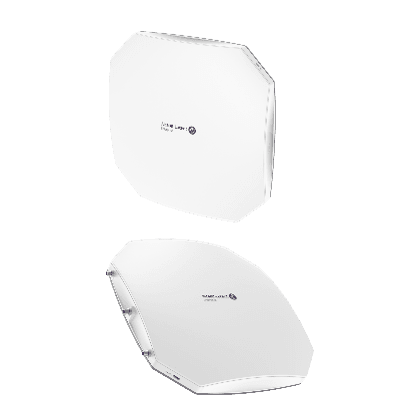
What makes it "high-range"
The AP1540 series doesn't just inherit the Wi-Fi 7 standard, it pushes the hardware configuration to its ceiling.
- Five built-in radios: 6 GHz 4x4:4 / up to 11.52 Gbps per client (EHT320),5 GHz 4x4:4 / up to 5.76 Gbps per client (EHT160), 2.4 GHz 4x4:4 / up to 1.376 Gbps per client (EHT40), dedicated full-band scanning radio, wIDS/wIPS and spectrum analysis running continuously without stealing from client radios and the integrated Bluetooth 5.4 / Zigbee radio, IoT connectivity, location services, building automation
- Maximum aggregate throughput: 18.67 Gbps.
- Dual 10GE uplinks, one combo RJ-45/SFP+ port and one 10GE RJ-45, both 802.3bt PoE-capable. The uplink isn't a bottleneck.
The dedicated scanning radio is a real differentiator. On most access points, scanning for rogue APs or RF interference means pulling one of your service radios off-duty. On the AP1540, the scanning radio runs 24/7 independently. Your client traffic is never interrupted for security scanning.
Where the access points belong
• Large venues and arenas: Think of a concert hall mid-show: 8,000 people, all trying to post simultaneously, stream audio, pull up set lists, or tap to pay at the bar. MLO lets each device transmit across multiple bands at once, cutting congestion and eliminating the wait. The AP1542 with directional antennas covers tiered seating from ceiling mounts without flooding backstage or neighboring sections with interference.
• Higher education: lecture halls and exam rooms: A 500-seat auditorium during finals every seat occupied, every student on a laptop or tablet. OFDMA splits each channel into sub-channels that serve multiple clients simultaneously. 4096-QAM pushes peak throughput 25% higher than Wi-Fi 6E. The result: the last student in the back row gets the same experience as the first row.
• Healthcare facilities: Real-time vital monitoring, wireless imaging transfers, staff communication - all running concurrently on the same network. Ultra-low latency via MLO and predictable QoS per application class ensure clinical-grade reliability. The dedicated scanning radio provides continuous wIPS protection without impacting medical device traffic.
• Warehouses and logistics hubs: High ceilings, metal racking, and thousands of RF reflections make standard APs unreliable. The AP1542 with external antennas solves the coverage problem. Zigbee integration handles IoT sensors and asset tracking on the same AP. The controllerless distributed architecture means no single point of failure, the cluster elects a new primary automatically if an AP goes down.


